Valley of Geysers
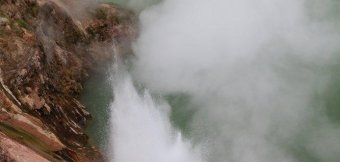
Valley of Geysers is a large geyser field located on the territory of the Kronotsky Nature Reserve in the Yelizovsky district of the peninsula, 180 km from Petropavlovsk-Kamchatsky. A visit to the Valley is becoming an obligatory point of the tourist program for many guests of Kamchatka. And this is not surprising — there are few places on the planet where you can see geysers. And the beauty of the surrounding nature makes this place even more attractive.
Opening history
The Valley of Geysers was discovered by chance when, in the spring of 1941, Tatyana Ustinova, a geologist from the Kronotsky Biosphere Reserve, and her guide Anisifor Krupenin went in search of the left tributary of the Shumnaya River. The scientist assumed that this tributary should carry water from the caldera of the Uzon volcano.
The eruption of the geyser caught a group of researchers by surprise — at first their attention was attracted by the release of steam, which Tatyana Ustinova took for a manifestation of volcanic activity. It was decided to reach the source of the emission. Some time before the expedition, a geyser eruption began. However, due to the weather conditions, further exploration of the Valley was impossible. The band decided to return here in the summer.
In the summer, the expedition explored the entire active part of the Valley of Geysers, described it in detail. The geysers were given names. The one that the scientist saw back in April was named the Firstborn. The largest source is called the Giant. In total, there are hundreds of underground springs in the Valley, of which more than twenty are large. The water temperature during an eruption can reach 95 °C or higher.
Geysers and ecosystem
The ecosystem of the Valley of Geysers is unique due to the microclimate created by high humidity and temperature. Thermophilic plants, uncharacteristic of the rest of the peninsula, grow here, for example, the Kamchatka turnip, the Pauzhetskaya vole and the Okhotsk fimbristylis, the Chinese curlew.
A striking representative of the Valley is the Ermana birch or stone birch, whose wood density is higher than the density of water, due to which the tree sinks. Ermana birch is included in the list of "Monuments of wildlife". Kamchatka fir, wormwood, Kamchatka lubka, warmwater grasshopper and other rare species grow in the Valley.
Its representatives are gulls, swans, golden eagles, bighorn sheep and brown bears that fish in numerous reservoirs.
The ecosystem has proven to be very vulnerable to external influences. Due to the high tourist flow, rare species of plants and animals began to disappear after the opening of the Valley. Therefore, in 1967, tourism in the Valley of Geysers was restricted, and in 1977 there was a complete ban on visits.
In 1993, it was decided to create conditions for tourist excursions. From now on, the length visits are under control, independent trips are limited.
The difference from the Small Valley of Geysers
The small valley is located near the Mutnovsky volcano, it can be visited as part of the Mutnovsky ascent, and you can also get there yourself. The small valley is a cluster of thermal springs. The water in the springs is heated by hot gases that accumulate underground. The effect of eruptions is created, but the nature of the eruptions is different from real geysers.
How to get to the Valley of Geysers
Helicopter tours are available to the Valley of Geysers, available only in summer. It is better to plan the tour in advance, as the number of seats is limited.
Where to stay
There are no settlements or equipped bases for living in the immediate vicinity of the Valley. Tourists can stay in Petropavlovsk-Kamchatsky, Yelizovo and other settlements.
Interesting facts
In 1981, the valley was hit by heavy rains caused by Typhoon Elsa. Due to rising water levels, a mud stream formed in the Geysernaya River, which led to the disappearance of some geysers.
In 2007, the Geyser Valley was flooded due to a landslide. Some geysers were under water. Gradually, the Valley began to recover, and a new landslide in 2013 helped this process and led to the formation of new geysers.
Special offers